

Handling Insect Pests on Your Roses
by Carol Chicci
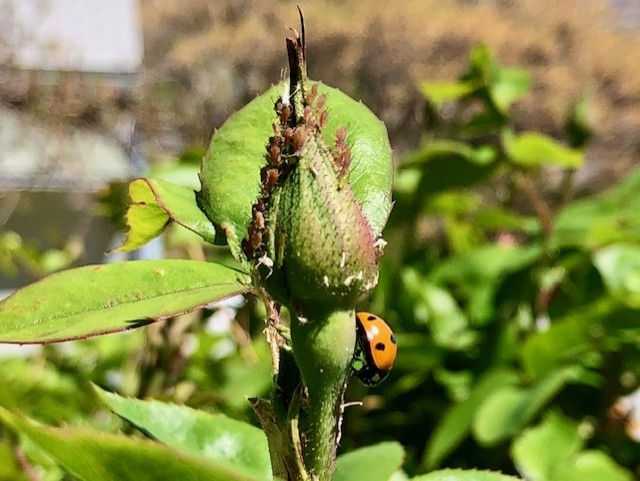
Rose pests arrive early, about the end of April, when we are occupied with planning our gardens. By that time thrips and aphids are already on some of the rose varieties in both my garden and in the Olivia White Hospice Garden. Thrips, especially, are very destructive, so you must act quickly to control them.
The common thrips in our region is the Western Flower Thrips. Thrips (which is both singular and plural) are about 1 mm to 2mm in length, thin-winged, white or tan insects. Thrips use their piercing, sucking mouthparts to feed on the juices of the rose bud and the new leaves that surround it until they are so dehydrated that the buds are unable to bloom. Two of the rose bushes in the Hospice Garden lost their entire June bloom this season because the rose buds and their protective leaves became so badly damaged that they withered and turned dark red. When this happens, you must cut away all of the wilted red new leaves and the wilted buds, put them in a bag, tie it, and throw it away in the trash. You can then spray the new buds with a solution containing Spinosad (an insecticidal ingredient) about every five days until the infestation ends.
The next insect pest to appear is the aphid. These rectangular insects are about 1/16 inch long, with a pair of tall jumping legs. The aphids on my roses are pale green and pack themselves tightly into rows and columns on the pedicel (flower stalk) of the rose bud. Their straw-like, sharp mouthparts pierce the pedicel and bud, sucking out the sap.
Spraying with strong jets of water will dislodge these pests from the pedicel, but can damage the rose bud. Removing them by hand is quick and efficient. With your fingers at the bottom of the column of aphids, encircle and pinch the pedicel while quickly pulling upwards. This will dislodge both living and dead aphids.
One of the aphid’s major predators is the ladybug, which is actually a beetle, a ladybird beetle. Both adult ladybird beetles and their larvae eat aphids. The larvae are black, each with a long bumpy ridge and a design of orange spots.
Spider mites are smaller than a grain of pepper, so an infestation is easy to overlook until it is well advanced. Spider mites are arachnids with two body parts and eight legs. They have piercing, sucking mouthparts, which they use to draw sap from leaves. If their numbers are great enough, the plant will wilt and perhaps die. To check for spider mites on roses, look for networks of fine silk webbing on the undersides of the leaves. Over time, the leaves curl and become marked with streaks and dots, as the mites feed.
You can destroy a spider mite colony by removing the webbing and the dried, crinkled leaves and putting them in a bag. (Be sure to tie the bag securely before putting it in the trash.) Then dislodge the rest of the colony with a thorough spray of water, making sure you reach the undersides of the rose leaves. Finally, rinse your gloved hands with a solution of water and alcohol. Monitor the plant, and repeat this process if more spider mites are found.
Spinosad is an insecticide ingredient that controls thrips, aphids, and spider mites. It is made from a bacterium that paralyses the insects, causing death. As a spray, it is safe for humans and pets after it has dried for three hours. It is slightly toxic to bees, so spray just before dusk when bees are not active.
Each year I now make it a practice to put insecticide at the top of my nursery list, and buy my insect control when I am purchasing those first plants. I think we can all agree that a showcase of June rose blooms following a long winter is too precious to be missed!
Carol Chicci, a certified Master Gardener of the Coconino Master Gardener Association, has grown roses in Phoenix for 15 years and for 21 years in Flagstaff. She is a member of the Denver Rose Society, the American Rose Society, and the Durango Botanic Gardens. Gardening Etcetera is written for the community by certified Master Gardeners of the University of Arizona's Coconino County Cooperative Extension Master Gardener Program. Have a gardening question? Visit our Online Plant Help Desk at https://extension.arizona.edu/programs/coconino-county-master-gardener.


Comments