

Daffodils Are Resting Up for Spring
By Laura Huenneke

As crisp fall mornings arrive, my thoughts turn to planting bulbs whose blooms will brighten the late winter and spring. Here in Flagstaff, I’ve become a huge fan of daffodils. They offer long-lasting benefits year after year, including pest resistance, tolerance of dry and hot summers, and early cheerful color.
Narcissus, the genus name, comes from a Greek myth. Narcissus was an extraordinarily handsome young man who could not love others. But when he saw his own reflection in a pond, he fell hopelessly in love with that image and wasted away, leaving only a gold and white flower in his place.
While narcissism is not an attractive personality trait, these flowers are widely admired and one of the most popular bulbs worldwide. Native to southwestern Europe and northern Africa, the genus comprises 70-80 species and many hybrids. Daffodils, also known as jonquils, are cultivated on nearly every continent. The Royal Horticultural Society in Britain tracks and registers named varieties, currently listing nearly 500. Several wild species are nearing extinction, threatened by habitat loss and by over-collection.
Narcissus flowers are usually showy, with a central trumpet or corona, and a surrounding “perianth” or ring of flower parts. The corona and perianth may be the same or contrasting colors and cultivated varieties may have doubled or frilled flower parts. There are 13 different “divisions” of Narcissus, categorized by the relative size and shape of corona and perianth.
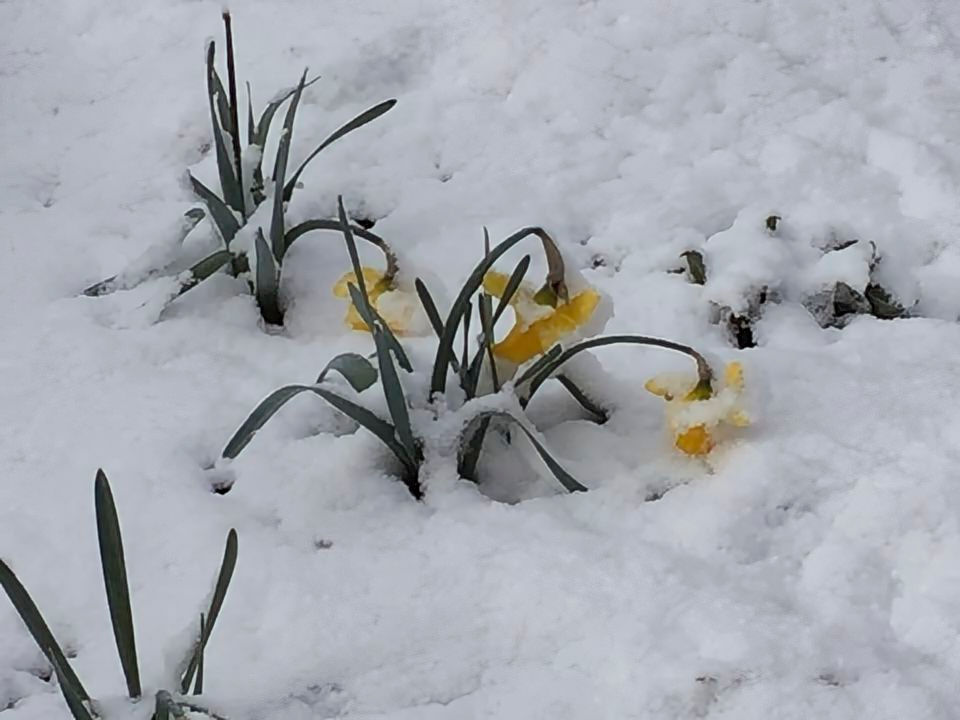
For most of us, daffodils are all about spring flowers, but the real story begins underground. Daffodil bulbs may not appear very dynamic, but they are very sensitive and responsive to environmental cues. The bulb initiates flower buds only after substantial exposure to cold. Then it responds to warming soil by starting the growth of flower stalks and leaves. Finally it senses lengthening daylight and unfurls those flowers and leaves above ground. Differing daylength requirements result in early, midseason, or late season varieties.
After flowering ends, the leaves continue to photosynthesize, storing energy in the bulb. Eventually the leaves die back and the bulb simply rests until the next spring. Remarkably, the drying roots can contract, actually pulling the bulb deeper into the soil.
Many varieties produce additional bulbs as the plant stores energy, leading to larger clumps. This proliferation over time results in naturalization—clumps spreading across the landscape. Photos of drifts of narcissus blooming in English woodlands inspired me to tuck bulbs into openings on an untended slope in my rural yard. Granted, my spring display is not quite so dreamy!
Although vegetative propagation of dividing bulbs is prevalent, daffodils can also reproduce by seed. They are insect-pollinated, and different kinds of insects visit different shapes or sizes of flowers. For example, the broad, open coronas of some daffodils, with anthers inside the corona but the stigma extending outwards, are visited by bees that actually enter the flower. But the narrow tubes of paperwhite types are pollinated by long-tongued insects like sphynx moths.
Fall is the perfect time to plant daffodil bulbs. You can even enjoy them indoors; paperwhite narcissus can be “forced” or grown indoors, if given a chilling treatment to simulate winter temperatures. Pay attention to the source of bulbs you buy – you don’t want plants taken from natural populations!
One advantage of daffodils is low maintenance. Even in dry springs, they don’t require much supplemental water. I have kept many healthy and propagating by watering a handful of bone meal thoroughly into the soil in spring while the leaves are green. After the foliage dries, one needs to do absolutely nothing until the next spring (unless you want to divide and spread them around).
My favorite feature, though, is that gophers don’t like them! Even in years and parts of the yard where gophers have churned up large areas with tunnels and mounds, the daffodils emerge unscathed the following spring. Deer avoid them also, thanks to toxic alkaloids. One western plant catalog company, High Country Gardens, even advertises some daffodil varieties as javelina resistant! Narcissus thrive in a wildlife-rich garden where many other cultivated plants are gobbled up like treats.
You are undoubtedly thinking about late summer harvests and fall garden cleanup rather than early spring flowers. But September and October are the best time to purchase and plant spring-flowering bulbs like daffodils. Keep your eyes open for bulb sales and for the spot in your yard where you can be delightfully surprised through late snows or early spring days!
Laura Huenneke is a plant ecologist, a certified Master Gardener, and the coordinator of the Gardening Etcetera column. Gardening Etcetera is written for the community by certified Master Gardeners of the University of Arizona's Coconino County Cooperative Extension Master Gardener Program. Have a gardening question? Visit our Online Plant Help Desk at https://extension.arizona.edu/programs/coconino-county-master-gardener.


Comments