
Crevice Gardens - Rooted in Stone
by Susan Lamb

Imagine creating a miniature mountain range in your garden, a tiny world of cliffs and clefts to care for and explore. In the 1970s, gardeners in the Czech Republic started doing just that. They built crevice gardens: waist-high imitations of their country's craggy mountaintops. Today, crevice gardens are found all over the world.
Every crevice garden is a work of art. Rocks can fan out on a slope, range in rows of vertical slabs, or rise in a pattern of hills to create a maze. Crevice gardens make a small yard seem larger and are much more attractive than retaining walls. Some crevice gardeners keep it simple, arranging a few stones in pots or in a small space to accent a larger garden.
Several illustrated books describe crevice garden styles and construction. Among the best are The Crevice Garden by Kenton Seth and Paul Spriggs, and The Crevice Garden and its Plants by Zdenek Zvolanek, the venerable pioneer of Czech style. An online search will lead to plenty more pictures and advice.
I was instantly captivated this summer by Seth Watkin's remarkable crevice garden here in Flagstaff. Seth has transformed his simple front yard into a small-scale landscape of stony ridges and rock-strewn terrain with flowering alpine, desert, and local native plants. To the side, a recirculating stream flows down a rocky channel into a pool lively with tadpoles and dragonflies.
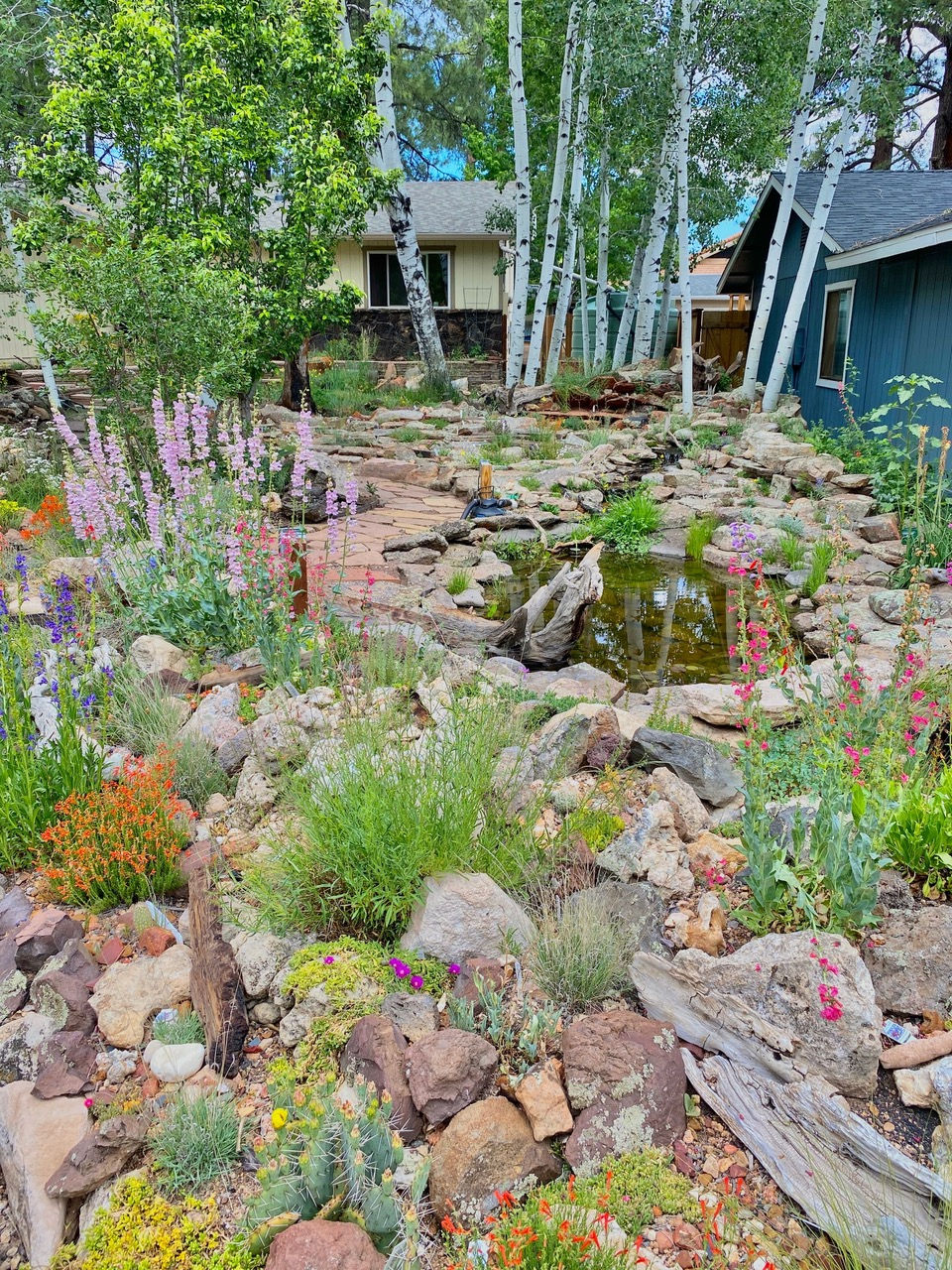
A runner, rock climber, and full-time hospital nurse, Seth began devoting his considerable energy to the project in early 2025. Building a crevice garden was intimidating; it was hard to picture how it would look. He started small with a long, narrow space along a flagstone path.
Learning as he went along, Seth cleared turf and weeds from the space where the first berm would go. He dug out 6 inches of clay soil along the path and set in large foundation rocks. After filling the space with 3 parts cinder sand and 1-part crushed limestone, he tamped it down. He piled cinder sand on top of that, to make a berm 3 feet at its highest point.
Working mostly from the top, Seth set upright slabs of lichen-spotted basalt 8 inches into the berm, 3 to 5 inches apart. He filled small spaces with interesting stones, placed attractive ones in easy view, and jumbled angular rocks around trees to keep their trunks from rotting. Between a few slabs, he left space for small boulders surrounded with pea gravel. To maintain the garden, he shaped subtle routes through the stones.
The stone slabs set close together resemble naturally stratified rock. Plants in the crannies between them grow long roots in pockets of porous soil, shaded from summer heat and insulated from winter freezes. The cinder sand keeps water from pooling and possibly, causing rocks to frost-heave in winter.

Alpine and desert plants thrive in coarse, porous soil with few nutrients. To plant, Seth pokes a piece of rebar into the cinder sand to make a deep hole. He drops in a little native clay soil and compost, knowing roots find their way down to nutrients. Gently loosening the soil from the roots of each each plant, he shimmies them into the hole, holding the plant in place while he fills in around it. Depending on what the plant needs, he sometimes adds a little compost or clay. He puts pebbles and pretty rocks on top.
Seth's garden is a changing canvas, evolving as he adds plants and moves those needing more space or light. He trades plants with friends and grows many from seed, finding unusual species through seed exchanges or on adventures to remote places.
Maintenance is straightforward. Spot-water to establish the plants. Remove fallen leaves and plant trimmings. Pull any weeds that appear.
Finding the right stone can take patience. Landscape companies selling flagstone and naturally formed rock slabs are scattered across northern Arizona, including Flagstaff. Some offer "moss rock" encrusted with lichen. Ash Fork's stone yards are known for the Coconino Sandstone quarried nearby. Alternatively, buy a permit from Coconino National Forest to collect malpais, river rock, sandstone, or sometimes red rock in designated areas.
Crevice gardens are ideal for Flagstaff. They can create microclimates a full USDA zone above or below a garden's normal range, defying temperature swings and weeks without rain. In summer, they keep roots cool and moist. In winter, the sun warmed rocks keep roots from freezing. Crevice gardens harmonize with their natural surroundings instead of imitating distant places.
Susan Lamb manages the habitat gardens surrounding the Willow Bend Environmental Education Center in Archuleta County Park. She is grateful to the Coconino Master Gardeners Association for their generous support of the habitat gardens over the years. Gardening Etcetera is written for the community by certified Master Gardeners of the University of Arizona's Coconino County Cooperative Extension Master Gardener Program. Have a gardening question? Visit our Online Plant Help Desk at https://extension.arizona.edu/programs/coconino-county-master-gardener.


Comments