
Buried Treasure: The Benefit of Ollas in Your Garden
By Jan Holland Hailey
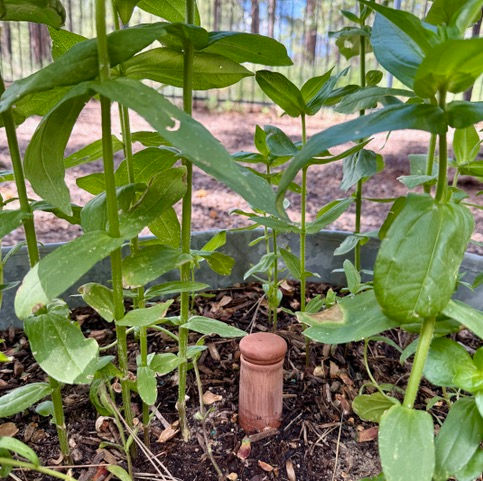
An olla [oy-yah], Spanish for “pot”, is a low-fired, unglazed and porous clay pot or vessel used since ancient times in gardening. When filled with water, it provides a slow release of moisture into the soil as an alternative or supplemental watering system. Ollas are believed to have originated in China or North Africa between 2000 and 4000 years ago in arid regions. Before European colonization, unglazed clay pots were used by indigenous people in the Americas, including our own Southwestern tribes, for subsurface crop irrigation.

Let me explain how an olla works. The vessel is buried in the garden soil with its opening above the surface and then filled with water. The tiny pores in the olla clay allow water to seep slowly into the soil as needed. Once an olla is placed, a type of forced suction is created by the soil moisture tension and the plant roots. When the soil becomes drier, the water in the olla will leach out more readily for the thirsty roots. If the garden receives rainfall or periodic irrigation, the olla will hold onto its water cache until needed, when the soil dries out again. Some studies observe ollas to reduce garden water use by 50%-70% or more.

The primary benefit of utilizing ollas is water conservation, since an olla eliminates evaporation of surface watering or irrigation. An olla can be a lower maintenance option for the garden, saving time and energy. When refilled a couple times a week or used during a vacation, it lessens the time between watering. I like to fill ollas from the rainwater harvesting barrels on my property. I’ve also filled an empty wine bottle with water and upended it in a filled olla when I’m planning to be away for an extended period. It’s a positive supplement to irrigated gardens, and especially helpful during hot, dry periods. Additionally, an olla promotes root health by directing moisture deeper to the roots and allowing the plant to develop a stronger, less stressed root system. Deep soaking is better than surface watering, resulting in denser root growth with consistent moisture at the root level. At the end of a season, I’ve observed the robust root growth surrounding an olla I’ve used in my garden.
This brings me to other considerations for using ollas. They’re known to work best on plants with fibrous root systems, so where they are used is a factor. There is an initial expense, and ollas may be considered “pricey.” Available where specialty garden supplies are sold, I believe “handmade” or artisan made, rather than mass-produced ollas, generally function better and endure. I consider ollas a good investment, because I’ve experienced lower water usage and improvements in plant health. I like ollas that have a lid or stopper to reduce evaporation from the opening, though a rock or cork can be used to cover the hole. Ollas are utilitarian, although they may appear to be an art object with a fanciful glazed lid. An olla is not too fragile, but it can break. Caution is required while placing them in hard soil with rocks and larger woody roots. If they are placed in the ground, a marker is often used to prevent the gardener from stepping on the top.

Caring for an olla is simple; they remain in place for an entire season. At the signs of first frost, I dig up the ollas, clean them and store them in a sheltered space for the winter. The next season I re-bury them based on how I’ve planted my garden.
This year in my garden I have ollas arranged in raised beds. Several are in use between Hopi corn rows, since the plants seem to thrive on consistent, deep moisture. Other ollas are placed near the base of Himrod grape plants. Some, including olla “stakes”, I’ve located successfully in containers and pots. There are many versions and options available, and I plan to add to my own supply to increase my use of these ancient slow-watering pots.
JAN HOLLAND HAILEY is a Coconino County Master Gardener and retired HR executive, who enjoys a garden that is creative, efficient and somewhat experimental. Gardening Etcetera is written for the community by certified Master Gardeners of the University of Arizona's Coconino County Cooperative Extension Master Gardener Program. Have a gardening question? Visit our Online Plant Help Desk at https://extension.arizona.edu/programs/coconino-county-master-gardener.


Comments